Article published on April 29, 2026
The ALMER-S project builds on previous work in absolute positioning for planetary exploration
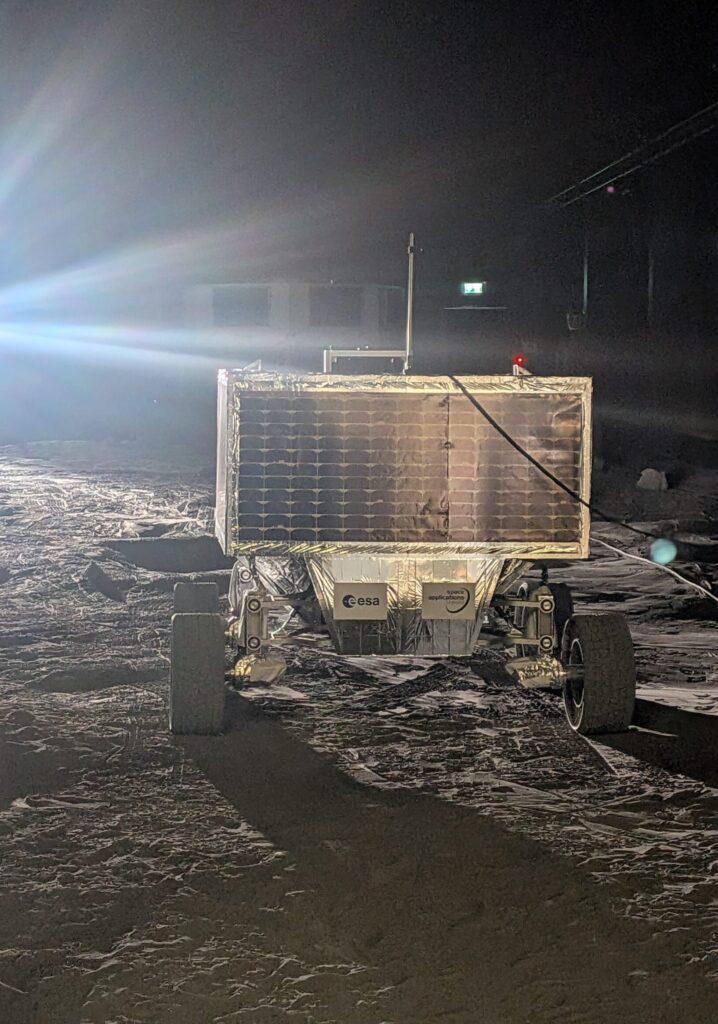
This new R&T initiative, launched in January 2026, builds on the ALPER (Absolute Localization for Planetary Exploration Rover) project—conducted with ESA support in a Martian environment—and the ALMER project—carried out with CNES to adapt the technology to lunar environments. It marks another significant milestone in the advancement of robotic systems operating in challenging environments.
On both the Moon and Mars, a rover’s ability to determine its precise location is a key factor in the success of missions. While relative positioning systems can currently track short-term movements, they accumulate errors over time. Absolute positioning, expressed in terms of latitude and longitude, makes it possible to correct these drifts andensure reliable navigation over long distances.
Since 2023, Magellium Artal Group has been developing innovative vision-based approaches capable of comparing images acquired by a rover with data from orbiting satellites. As part of the ALPER project, we have developed methods tailored to a Martian environment, characterized by the availability of high-resolution satellite images and a high concentration of rocky features.
With ALMER, these techniques were adapted to the lunar environment, where conditions are even more challenging: low-angle lighting, sharp shadows, high contrast, and a large number of craters. These specific conditions required algorithmic adjustments to maintain the accuracy and robustness of position estimates.
Incorporating the semantic dimension into vision-based localization
With ALMER-S, the goal is to take things a step further by introducing a new, so-called semantic approach to absolute localization.
In practical terms, this is no longer just a matter of comparing geometric structures across images, but of incorporating the nature of the elements observed in the environment: rocks, craters, or even terrain contours. These elements become reference points that are identified, characterized, and utilized differently depending on their properties and the challenges associated with them.
This development makes it possible to:
- To improve resilience in the face of terrain variability,
- To reduce sensitivity to lighting conditions,
- To make the methods more adaptable to different planetary environments.
By combining various types of landmarks with comparison strategies (such as Crater or Shadow Matching and Digital Image Correlation), ALMER-S overcomes certain limitations observed in previous approaches, particularly in complex environments such as the lunar South Pole.
Magellium Artal Group’s expertise in space robotics and vision-based absolute positioning
With ALMER-S, Magellium Artal Group is solidifying its position in the field of autonomous navigation for space exploration, building on its long-standing expertise in computer vision and space robotics, which has been developed through numerous projects.
The work carried out within ALPER has, in particular, demonstrated, on similar terrain, that the vision-based absolute positioning solution can achieve an average accuracy of approximately 0.5 meters (or about 2 pixels on the orbital image), with 98% of estimates below 1.25 meters (and up to 99.8% under optimal terrain and topography conditions).
These approaches were then adapted and tested in a simulated lunar environment as part of the ALMER project, demonstrating both their effectiveness and their limitations, particularly with regard to lighting challenges.
ALMER-S builds on existing work with a clear objective: to enhance the robustness of the algorithms and expand their adaptability to a wider variety of terrains, while continuing to advance the maturity of the associated technologies.
We are eager and very proud to continue this work alongside CNES and to contribute to the development of increasingly autonomous navigation solutions for future exploration missions.
To stay up to date on the project's progress, follow us on social media!